
What does this mean, and what might it help us understand?
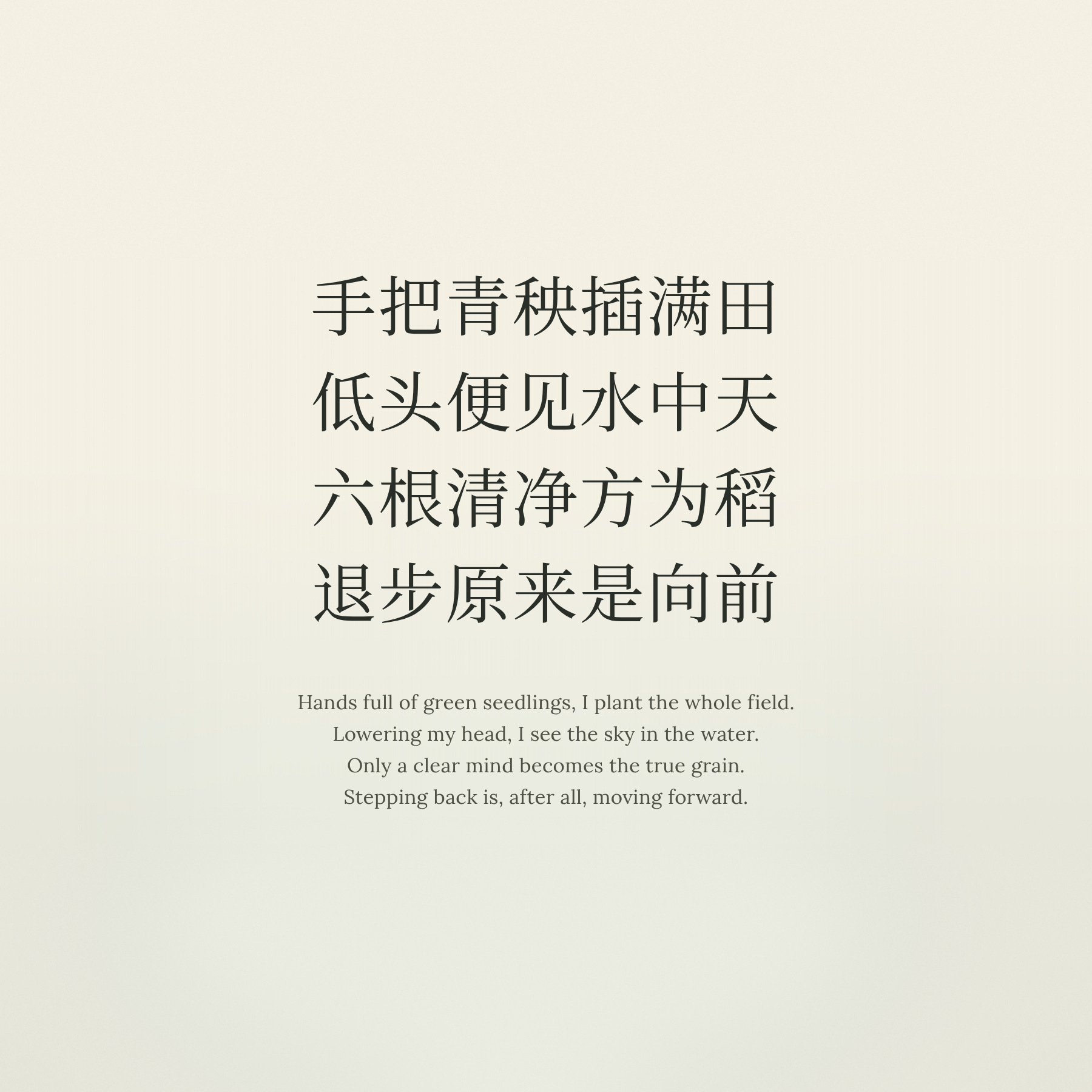
手把青秧插满田,
低头便见水中天。
六根清净方为稻,
退步原来是向前。Hands full of green seedlings, I plant the whole field. Lowering my head, I see the sky in the water. Only a clear mind becomes the true grain. Stepping back is, after all, moving forward.
These lines are often attributed to the monk Budai. They describe something simple. A farmer plants rice by walking backwards through the paddy. Head bowed, he sees the sky reflected in the water at his feet. Every step back leaves a row of green behind him.
Imagine a friend called Wei. He is driven and sharp, and he has always moved forward. He sets a goal and goes straight at it. For years this works.
Then it stops working. He pushes harder, and one attempt fails. He tries again and fails again. One failure leaves him lower than where he started. Pushing is the only way he knows, and it is no longer enough.
So one day he stops. He does not quit. He simply steps back. For the first time in years he looks at the whole picture instead of the next target. What he sees surprises him. There were paths he had walked past without noticing, and people who had been trying to help.
He did not see the sky by looking up. He saw it the way the farmer does, in the reflection at his feet. He found it in his own mistakes and in the quiet after the noise.
Many of us know someone like Wei. Some of us have been him. We are taught that progress means forward, always forward. Yet the rice farmer plants a whole field walking backwards.
Perhaps a step back is not a retreat. Sometimes it is the only way to see where we really are.
退步原来是向前。
Read next: 梅花香自苦寒来: What a Chinese Inkstone Taught Me About Hard Seasons and The Summit With No View.
A more mindful way to explore life.