
How does the world feel through our senses?
Growing up, one of the ways I used to express how I felt was through music; for me, music and mood went hand in hand. When I was happy, I would be humming and singing along to the top 40 charts of that week. When I was upset and angry, I would blast rock music like Jon Bon Jovi from my little radio in the room.

As I got older, I began to notice that music did more than reflect my mood. It could also change how I felt and what I was able to do. For example, driving home after the morning drop-offs was where energy dips and the drive might seem dreary. The jazz playing in the background at 7.30am which was perfect for concentrating in morning slow traffic now seems to lull me to a state of daydreaming. This is where my playlist of sing-along pop music wakes me up, leaving me singing badly and happily at the top of my voice, beating along on the steering wheel like a one-man band. A familiar pop song lifted my energy but I know frantic techno would leave me tense and checking my blind spots too often like a headless chicken.
Music and mood are closely connected. The songs we choose do more than colour a moment; they can quietly shape how we move through it.
Different moments ask for different music
No two people have the same playlist for the same moments. You might need music with a pumping beat to be running on the treadmill whilst others may prefer an audiobook.
That same playlist that I love to listen to while driving? It becomes a huge distraction when I am trying to have conversations with the family after dinner to catch up on the day and spend time with each other. The songs with catchy tunes and the chorus we know by heart now interrupt the conversation we are trying to have, making it difficult for us to be present in the conversation and listen with both the heart and the ears.
What changes is not the music, but what we are asking of ourselves. Some moments ask us to wake up. Others ask us to settle, to listen to another person, or to hold a difficult thought steady. When the music matches the request, we barely notice it – letting it fade into the background. When it does not, we notice very quickly.
Music plays an integral part in our lives – mostly in the background, but always with purpose
When the music is wrong for the work
I learnt this lesson the hard way. Some afternoons I sit down to write a proposal or work on an analysis, and the music in the room is loud, bright and relentless. Nothing is wrong with the song. It is simply too booming for the task, and I find myself rereading the same paragraph three times, then feeling oddly annoyed, as though the music were arguing with me.

Volume and intensity can compete for our attention. When a task already asks us to concentrate, music that demands notice may make that concentration harder. For a long time, I thought this was only a matter of taste but research offers another way to understand that feeling.
What research says about music and mood
A useful example comes from a 2001 study by psychologists William Forde Thompson, E. Glenn Schellenberg and Gabriela Husain. Participants completed a spatial reasoning task after silence or after listening to music. Performance was better after a pleasant, energetic Mozart sonata than after silence, while a slow, sad Albinoni adagio did not produce the same result. When the researchers accounted for how aroused and cheerful each piece made people feel, the difference disappeared.
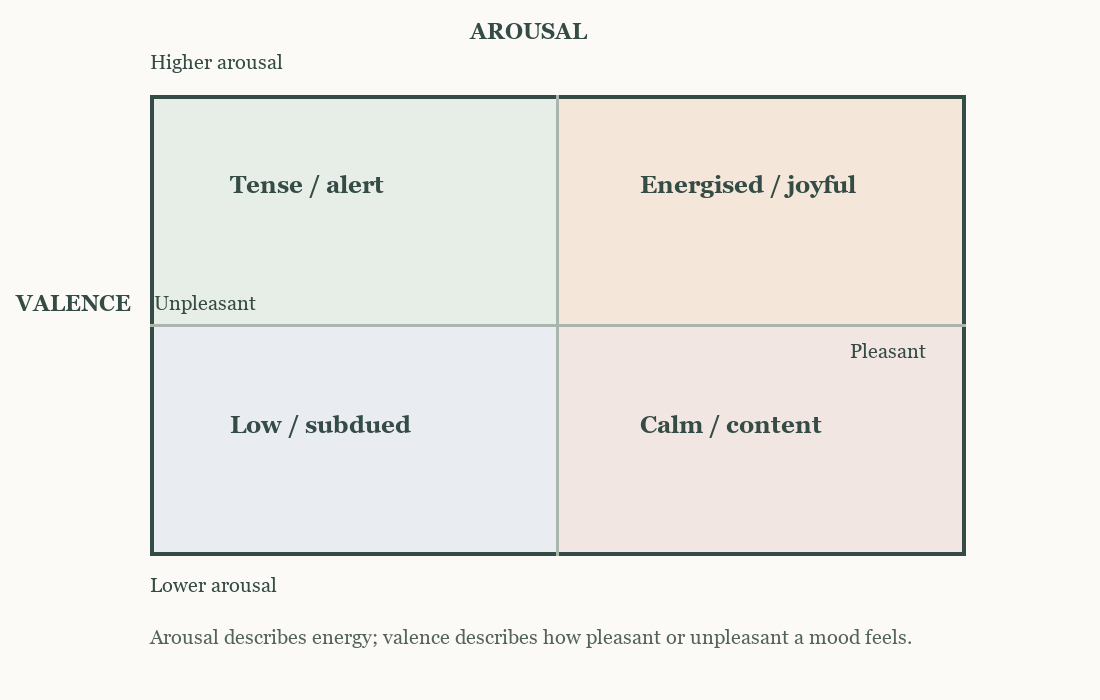
The finding suggests that music was not acting like a magic switch in the brain. It changed how alert and how pleasant people felt, and those shifts were linked to their performance. Music can affect us through both energy and mood, which helps explain why an upbeat chorus helps on a boring drive.
Listening as a small act of care
Perhaps the real skill is not finding one perfect playlist, but learning to ask a simple question before we press play: what does this moment ask of me?
A dreary drive may ask for lift. A long conversation may ask for a soft floor of sound, low enough that every word across the table is heard. A demanding piece of work may ask for something steady and wordless, or for nothing at all. Paying attention to that question is its own quiet form of mindfulness, the same close listening that gives this site its name.
I have started to notice how often I let music simply happen to me. It plays in the car, in the kitchen, in the shop down the road, and most of the time I am not really listening at all. Yet the moments I remember are the ones where I chose the music on purpose: a slow song on a rainy Sunday morning with my coffee still too hot to drink, or the whole family singing off-key to an old favourite on our roadtrip.
Being mindful does not mean switching off the music and sitting in silence. It means being present enough to notice what is playing, how it makes us feel, and whether it is helping the moment or crowding it out. Sometimes the most mindful choice is to turn the volume up and sing badly. Sometimes it is to turn it down so we can hear the laugh across the dinner table. Both are ways of enjoying the moment we are actually in, instead of rushing through it on the way to the next one.
The next time the music in the room begins to feel like an argument, it may simply be the wrong song for the hour. Turn it down, change it, or let the quiet in, and notice what the moment becomes.
Source: Thompson, W. F., Schellenberg, E. G., and Husain, G. (2001). Arousal, mood, and the Mozart effect. Psychological Science, 12(3), 248–251. PubMed
A more mindful way to explore life.